For the first six Star Wars films, there is some confusion about how to watch them “properly”. Some people believe that they should be seen in episodic order, others believe they should be seen in the order they were released. Both of these approaches have different issues when it comes to the way the story unfolds. If you watch in episodic order, the plot twists of the original trilogy get spoiled long before they are revealed. If you watch them in release order the last film ends on a very down note with thousands of Jedi being massacred, the hero falling to the dark side and the galactic empire rising up from the ashes of the republic.
Then there is the “machete order”, a third option that cuts episode 1 out entirely and sandwiches episodes 2 and 3 between 5 and 6. The reason this order exists is because a fan hated Jar Jar Binks so much that he decided to act as if The Phantom Menace didn’t exist. Full disclosure, I used to be on the Jar Jar hate train. The first Star Wars article I wrote was a review of a mashup of the prequel trilogy that took five minutes from Phantom Menace and just over an hour of scenes and deleted scenes from Attack of the Clones and Revenge of the Sith to essentially focus in on the Anakin and Padme love story, minimize cringe moments, maximize time together (through deleted scenes) and make the chemistry between the two characters flow better.
I have changed since writing that article. First of all, I think the prequel trilogy as it stands is pretty great. Does it have some issues? Of course, but the pros far outweigh the cons in my opinion. I also like the sequel trilogy (mostly). I’m one of those geek fans who prefers to focus on what I enjoy instead of complaining about what I don’t like. I’ve been swept up with the crowd a few times over the years. I took a few digs at Jar Jar when I was more interested in being accepted by readers at the Escapist than being a kind human being. The “Darth Jar Jar” theory opened my eyes quite a bit, plus I learned that Ahmed Best almost committed suicide thanks to the venemous hatred of the Star Wars fan base, and that’s just not ok in any galaxy.
The end result of this personal journey is that I have come to love The Phantom Menace and would like to offer up an alternative to the Machete Order that doesn’t omit an entire film, and actually enhances the series when viewed from this angle.
May I present to you “Star Wars: Yin Yang Order”. This is, in my opinion, the ideal way to view the first six episodes of the saga. It takes both trilogies and scrambles them together a bit. This viewing order reminds me of the way a yin yang isn’t just a circle with a white side and a black side that has a straight line dividing them (which is what you get with both release order and episodic order). The first half is the “Light father” trilogy (IV, I, V), and the second is the “Dark father” trilogy (II, III, VI).
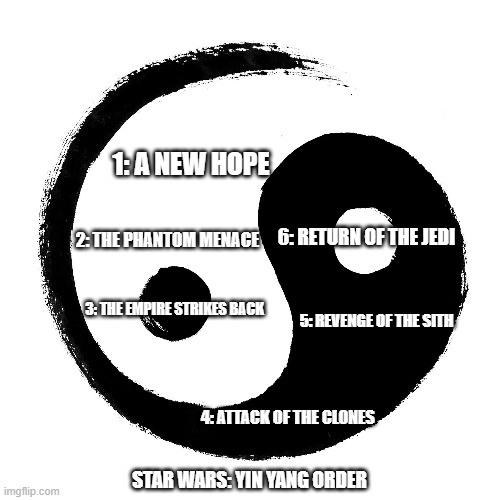
When George Lucas was first hashing out the saga, he made Darth Vadar and Anakin Skywalker as two separate characters. He referred to Vadar as the “dark father” and Anakin as the “light father”. This order enhances that sense of duality.
The Light Father trilogy starts with the first Star Wars film ever made, which introduces many of the characters, as well as the concept of the force itself. It presents Anakin Skywalker as a hero of the clone wars, and there is no reason to believe otherwise. Following up with Episode 1 maintains that illusion while also diving deeper into the world. It introduces more characters while presenting others in a different context. For example, Obi Wan dies as an old man in Episode IV, and in Episode I he is shown as a very young man who sees his own mentor die in a lightsaber battle, and then avenges him and kills a Sith Lord. A New Hope introduces the galactic empire and the rebellion against it. The Phantom Menace introduces the galactic republic in a state of relative peace. Seeing the two films side by side is jarring and raises a number of questions. It also shows how Luke was following in his father’s footsteps because both films end with a skywalker flying a small fighter and blowing up a mothership of some kind to save the day.
The Light Father trilogy ends with episode V. Now padded with a richer backstory, it continues the story of Luke and shows him training under Yoda to be a Jedi. Both Yoda and Darth Sidious were introduced in Episode I, so seeing them appear in V is more like a reunion than an introduction. However, the twist of Vadar being Luke’s father hits much harder this way, since there has already been a film featuring Anakin Skywalker as a “good guy”. Also, as it just so happens, in these three films both Skywalkers wear light colored clothes.
Moving on to the Dark Father trilogy, this is where you see both Anakin and Luke wearing black. By this point, viewers are deep into the world and the story and have some immediate questions about the dark side, how Anakin became Vadar, and what will happen to Luke. Starting with Episode 2, this next trilogy begins to answer some of those questions. It shows an older Anakin who is much closer to Luke’s age. He has been in Jedi training for ten years and is powerful in the force, but also arrogant and emotional. You watch him start to slip into the dark side. It starts with a disrespectful comment to Obi Wan, and before you know it, he’s decapitating Sand People men, women, and children off camera. The mirroring between Luke and Anakin continues with Anakin losing an arm at the end of Episode II, similar to how Luke lost his hand at the end of the last film in this order. But this time, the mirroring isn’t like it was with the Skywalkers blowing up ships with their little fighter craft and R2D2 helping. No, now the mirrors are unsettling. Especially for people who are watching for the first time and somehow don’t know the plots of the films or how the story ends. Attack of the Clones also has an image of a yin yang in clouds at the exact halfway point of the film, which is cool.
Episode 3 is the middle of the trilogy. This is that film where the bad guys win. One of the few films where that happens. The only other blockbuster franchise that I can think of where the bad guys win would be The Godfather series, which doesn’t really have any “good” guys. Just bad guys you root for, and bad guys you don’t. Even slasher films have some person who represents the forces of good and “kills” the bad guy at the end of the movie. Not Revenge of the Sith. That film goes all in. It may end with that hopeful Luke Skywalker music theme and the twin sunset on Tatooine, but that doesn’t change anything about what happens. The galactic government has been destroyed and taken over by space Hitler, all the heroes have either died, turned into villains, or gone into exile, and there is nothing anyone can do about any of it.
In the three-act structure of storytelling a lot of times the second act ends on a cliffhanger, and then the third act resolves the conflict and brings victory to the heroes. That’s what “feels” right to the audience. The final film in this order is Return of the Jedi. Having this back-to-back with Revenge of the Sith gives context to the arrogance of Palpatine. It’s also disturbing to see Luke Skywalker wearing all black and force choking the guards at Jabba’s palace in the first fifteen minutes or so. Darth Vadar is seen as both a tragic figure and a child-murdering monster. The tension of the throne room confrontation between father and son and the temptation of the emperor has a lot more gravity to it. And when Vadar saves Luke at the end he is not only helping his son, but also atoning for his own sins.
So, there you have it, friends, family members, and fellow Star Wars geeks. The “Yin Yang” order, which has a little darkness in the light father trilogy and a little light in the dark father trilogy. It starts with A New Hope and ends with the Return of the Jedi, it maintains the order of plot twists with the one exception of Master Yoda being introduced in Phantom Menace first instead of Empire (but even that works better this way, in my opinion). Having watched the series in this order recently, I can say that this is the most satisfying way to experience one of my favorite stories set a long time ago in a galaxy far, far away.
 The resistance is dead (the blog)
Leave a comment