In this blog I’m going to talk about different aspects of my book series. I would like to minimize spoilers for anyone who hasn’t read them yet, but I can’t make any promises. I will pick certain themes and subjects to explore in-depth for the benefit of providing bonus content to those of you who have already read the trilogy, while hopefully convincing those on the fence.
Today I’d like to talk about my decision to do a “self-insert” in my series. In case you didn’t already know, a self-insert is when the writer of a book, play, movie, or video game writes themselves into the plot of their story. There are two different kinds of self inserts. I’ll refer to one as a vague self-insert, and the other as a direct self-insert.
Vague self-inserts are fairly common. Those are characters with their own name, and back story, who have traits of the author and who the author chooses to relate to in telling their story. Those are usually safe and inoffensive to the general rules of fiction writing.
Direct self-inserts, on the other hand, are rare, and usually a bad idea. Pulling one off is a challenge that most reasonable storytellers choose to avoid. When a writer does a direct self-insert, they conjure a character named after themselves, based on themselves, to interact with a world that came from their imagination. It can get very messy very quickly, and it can really interfere with the suspension of disbelief. If it is done well, it can be an effective tool, but it is certainly a tricky thing to pull off.
Before I get into my own stories, I’d like to explore some different examples of self-inserts that I have encountered in pop culture, starting with one of my favorite authors: Stephen King. I was introduced to him way too young, in the fourth grade. This was about two years after my dad died of cancer, and three years after I lost my baby brother to SIDS. In school an older kid named Tim gave me a copy of It one day and I was immediately hooked. I related to the Stuttering Bill character, because his parents were traumatized and disconnected as a result of the death of his younger brother. I knew exactly what that felt like.
Ironically Stuttering Bill ended up writing horror fiction, just like me, and just like Stephen King. In fact, when it comes to vague self-inserts, Stephen King is a repeat offender. In story after story one of the main characters is a novelist, or aspiring novelist. Most often they live in Maine. Bill Denbrough in It, Jack Torrence in The Shining, that poor, poor soul in Misery. The list goes on and on.
After decades of telling stories, Stephen King decided to up the ante and go for a direct self-insert midway through the sixth book of his Dark Tower series. That was the first time I was introduced to the concept. I remember being absolutely flabbergasted when I read the part where Stephen King, the author, gets saved by his characters from a car accident that actually almost killed him in this world. I remember when I got to that part, I slapped the book shut, and just sat there in shock for a few moments. I’d never seen or heard of anyone doing that before (although it has been done before, numerous times, by numerous creatives. Wes Craven, for example, did it almost a decade earlier in his film Wes Craven’s New Nightmare). It felt like the very rules of fiction were being put in a blender, and I loved it.
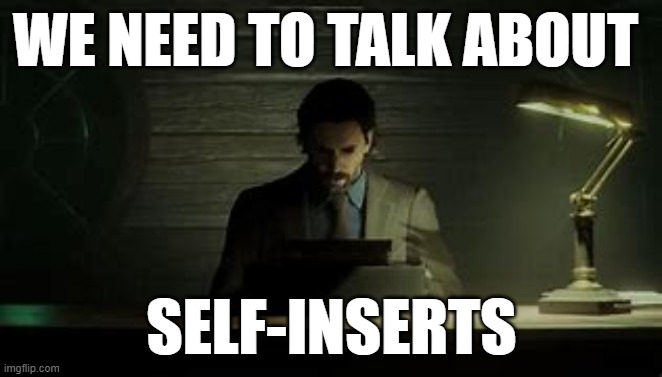
The next time I encountered that perspective was in the game Alan Wake. The plot of the game is a writer who is living out the events of a book he wrote in a week. The problem is, he has no memory of writing that book. His wife is also missing and the whole thing plays out the idea of a story-within-a-story on a masterful level. You find pages of the manuscript along the way, and then play through the scenes described in those pages a few minutes later. The interesting thing about Alan Wake is the way the game’s writer Sam Lake uses Alan himself as a self-insert. This is like Inception levels of storytelling, and I’m all for it. Alan Wake writes himself into his own story in the game, while Sam Lake based Alan off of his own experiences with writing in games. The fictional crime series that the character Wake had recently finished writing was a reflection of the Max Payne action crime games written by Sam Lake. The struggles of starting something new that the character Alan Wake deals with in-game reflects similar feelings the writer had about the time between the first game series and the creation of the Alan Wake game. There are a few interviews where Sam Lake describes his process with that project. Once you see it, it becomes hard to unsee.
Getting back to my series, I started off with a vague self-insert through the character Patrick Mills. He was mostly based on me, at least at first. It helped me to feel more grounded in that world. I was a regular freelancer at Escapist Magazine when I started that first book. I had already encountered a few people in real life who had read articles that I’d written. I wasn’t famous by any stretch, but I had a platform where I was paid to geek out. I also had a day job. Patrick Mills was a zombie geek with a small platform through his YouTube channel who also had a day job. The Reggie character was inspired by my friend of the same name, and if I hadn’t already chosen to include him in the story, I most likely would not have had the guts to do the same to myself in book 3.
In just a couple of chapters both Patrick and Reggie veered away from their respective sources of inspiration and became their own characters. This is how it should be, I think. Characters should have a life of their own. They should make choices or mistakes that surprise you. They should not fit nice and neat into a box of personality, because real people don’t usually fit nice and neat in any box either. Life is messy, and that is part of what makes it beautiful.
When I went a step further with my own direct self-insert in the last book, as soon as I plugged a character based directly off of me into that world, he started to veer away from the source material and become his own character. Because he was in a different situation with different choices and surroundings. As an introvert, I’m still not exactly comfortable having a book with a character based off of me blabbing his mouth about different stories I never thought I’d share with the general reading public on that level. My own discomfort combined with the obvious discomfort of my direct self-insert character made the concept seem workable to me. It felt like the opposite of a “Mary Sue” character, who is usually a self-insert character without any personal flaws or shortcomings or growth arc (In other words, boring!) My character felt more like a Sad Sam or a Bad-Luck Buck than a Mary Sue. If it felt like a Mary Sue to me, I would have trashed the document and started the story from a different angle.
In my journey so far, every now and then a story idea pops up in my head about a situation and my immediate reaction is, “Oh no, that would be terrible…I love it!” Something about the tension of certain situations that draws the imagination into a fun and messy place where good stories happen. After four years of writer’s block, and considering how weird things have been on our side of reality, jumping the shark and going for a full direct self-insert was the spark that broke my writer’s block and led to a novel that is forty pages shorter than my first two books put together, and brings what I feel (and I hope you agree) to be a satisfying conclusion to a story that was left in limbo for four years.
 The resistance is dead (the blog)
Leave a comment